
SharpEdge: Edge Feature Surface Reconstruction From Space Curves
Paper
Supplementary Material
Code
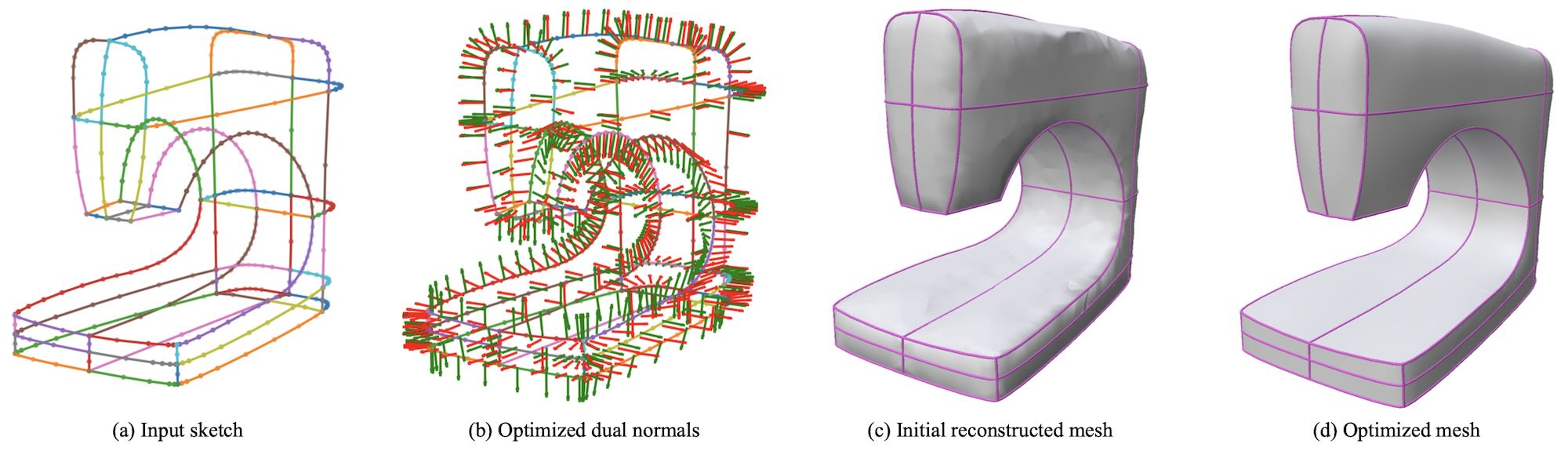 (a) Input 3D curve network. (b) Optimization of a two‐normal field along curve edges. (c) Initial surface reconstruction guided by the estimated normals using the generalized signed‐heat method. (d) Final surface after a cut–remesh–optimize pipeline producing well‐shaped patches that interpolate the features.
Abstract
Reconstructing high‐quality surfaces from sparse 3D space curves remains challenging, particularly when sharp feature edges are involved. Existing methods often reconstruct smooth surfaces that ignore sharp edges, depend on a failure‐prone automatic initialization procedure, or rely on manual intervention for initial surface estimation, all of which can lead to a loss of intended structure. We introduce SharpEdge, a framework for edge‐aware surface reconstruction from sparse (possibly disconnected) curve networks. Our method optimizes a two‐normal field along curve edges and enforces geometric constraints at curve junctions to better capture sharp feature directions. Guided by these normals, we reconstruct an initial surface using an adapted signed‐distance heat method [FC24] and refine it with a cut–remesh–optimize pipeline that produces fair surface patches interpolating the features. In our experiments on a range of 3D sketches, SharpEdge produces meshes that adhere closely to input curves and recover sharp ridges and corners that are often smoothed out by alternative approaches.
BibTeX
@article{Yu:2026:SharpEdge,
  author   = {Yu, Xue and Sheffer, Alla and Carr, Nathan and Gingold, Yotam},
  title    = {{SharpEdge}: Edge Feature Surface Reconstruction From Space Curves},
  journal  = {Computer Graphics Forum (CGF)},
  year     = {2026},
  volume   = {n/a},
  number   = {n/a},
  pages    = {e70581},
  keywords = {curve networks, feature curves, geometry processing, shape modelling, surface reconstruction},
  doi      = {https://doi.org/10.1111/cgf.70581},
  url      = {https://onlinelibrary.wiley.com/doi/abs/10.1111/cgf.70581},
  abstract = {Abstract Reconstructing high-quality surfaces from sparse 3D space curves remains challenging, particularly when sharp feature edges are involved. Existing methods often reconstruct smooth surfaces that ignore sharp edges, depend on a failure-prone automatic initialization procedure, or rely on manual intervention for initial surface estimation, all of which can lead to a loss of intended structure. We introduce SharpEdge, a framework for edge-aware surface reconstruction from sparse (possibly disconnected) curve networks. Our method optimizes a two-normal field along curve edges and enforces geometric constraints at curve junctions to better capture sharp feature directions. Guided by these normals, we reconstruct an initial surface using an adapted signed-distance heat method [FC24] and refine it with a cut–remesh–optimize pipeline that produces fair surface patches interpolating the features. In our experiments on a range of 3D sketches, SharpEdge produces meshes that adhere closely to input curves and recover sharp ridges and corners that are often smoothed out by alternative approaches.}
}